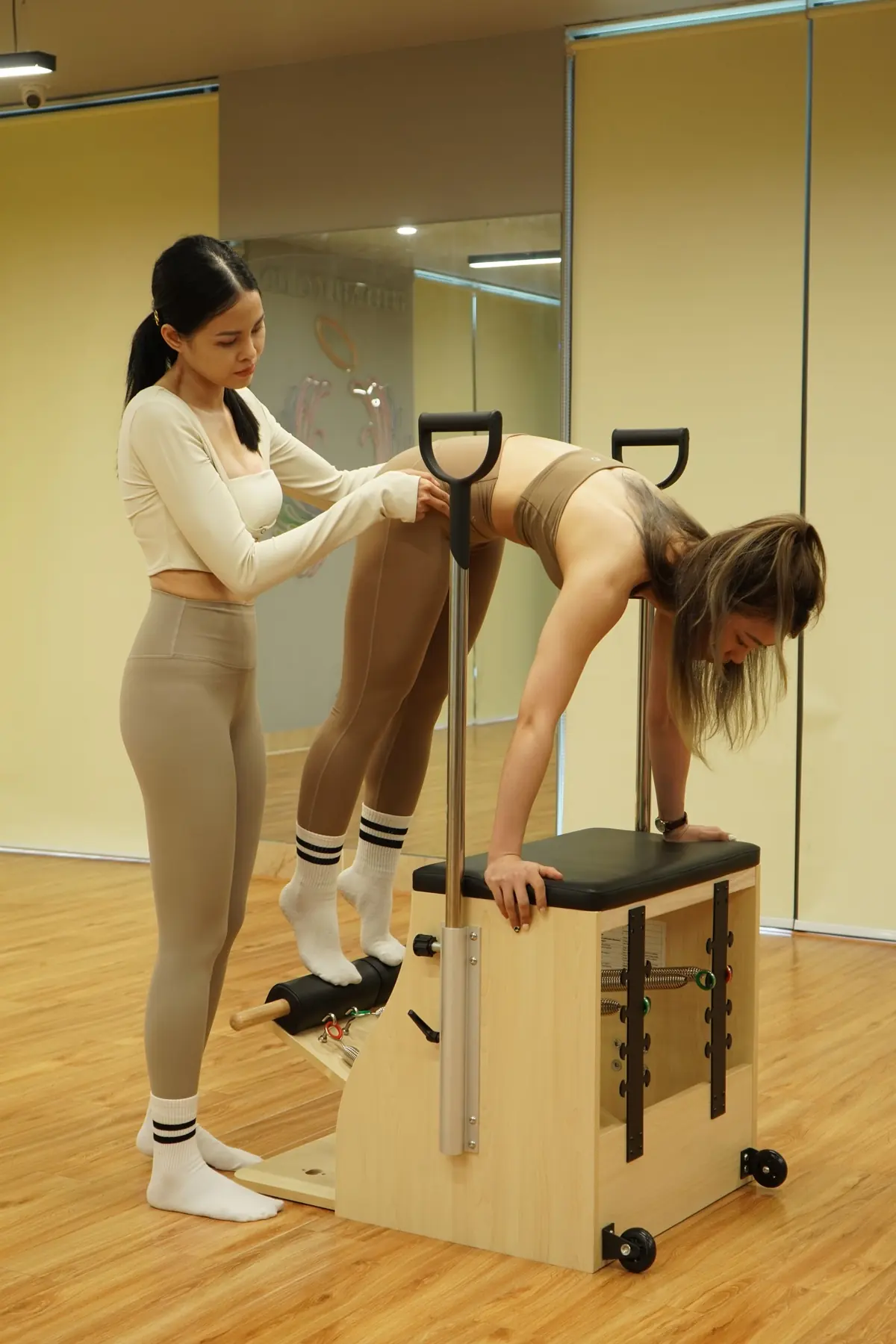
A thoughtful approach to the hour.
Daniel Brooks brings a thoughtful and personalized approach to Pilates, focusing on mindful movement, proper technique, and individual progress. His teaching style combines Reformer and Mat Pilates, emphasizing balance, flexibility, and controlled movement.
With a calm and encouraging approach, Daniel aims to create a welcoming environment where beginners and experienced participants can feel comfortable and confident. The room he teaches in is meant to be quiet enough for a cue to land. You should be able to try a shape, notice what changed, and ask for the next correction without feeling hurried past the point of the exercise.
Reformer and mat, in one teaching style.
On the reformer, Daniel stays with the setup before the range grows. Feet, head, and hands are placed first. The carriage should travel smoothly. Springs are chosen for the exercise, not as a test of strength. Straps come in when the path is clear. If a movement chatters or you grip the rests, he would rather change one detail than ask you to push through it. Balance, flexibility, and control are the qualities he keeps returning to, whether the exercise is a small range or a longer one.
On the mat, the same priorities hold, with fewer objects between you and the shape. Placement, breath, and the path of the limbs do the teaching. A newer student is given fewer variations and more time to find the position. Someone who already knows the classical order can be given a fuller sequence. Daniel does not treat the mat as a lesser hour. A precise mat exercise can ask more control than a supported carriage exercise, and he teaches it that way.
You can ask for one format or for a mix. Many people start on the equipment that feels less mysterious and add the other once the vocabulary is familiar. Say which you want when you write. If you do not know, say that. A first reply can recommend a starting point without locking you into it.
Beginners and experienced participants.
Daniel’s classes are built so both ends of that range can belong in the room. A beginner is not asked to perform a sequence they have not been shown. The first hour is mostly vocabulary: how to lie down, sit, and stand for the work, where the feet go, and how to follow a cue without rushing. Athletic experience is not a requirement. What helps is a willingness to repeat a simple shape until it is clear.
An experienced participant is not walked backward through an introduction they do not need. Tell Daniel what you already practice and what you want a closer look at. A private hour can stay with two or three exercises. A group can keep the shared plan and still leave room for a more precise version of the same shape. Individual progress, in his teaching, means the session fits the person who came, not a generic level posted on a wall.
The environment is meant to feel welcoming either way. Questions are part of the hour. A calm correction is more useful than a loud one. You should leave knowing what to repeat, not wondering whether you were adequate. Confidence, in this studio, is the result of understanding the setup.
What to expect in a session with Daniel.
Arrive in clothes you can move in. Fitted enough that the line of the body is visible, comfortable enough that you can lie down and roll. Ask whether grip socks are expected if the hour is on the reformer. Bare feet are common on the mat. Bring water if you like. Leave medical history out of the note you send ahead; a practical line about experience and goals is the right length.
The session itself opens with a short conversation about what you want from the hour, then a warm-up you can follow. Exercises are chosen for that visit. Daniel will emphasize technique when a shape is almost right, and he will change the load or the range before he changes the exercise. Balance and flexibility are trained as control, not as party tricks. Nothing in the hour is a medical treatment, a rehabilitation program, or a promise about pain or body shape.
Private work gives you the pauses. Group work gives you the shared plan and the chance to learn by watching as well as by doing. Both are available to request. If you are pregnant, prenatal Pilates is not offered as its own class; ask your clinician what movement is appropriate, and tell the studio before a visit so a standard session can be discussed honestly.
How to ask for a session.
Use the contact form, call +1 (305) 754-2905, or email [email protected]. Say that you would like to work with Daniel Brooks. Name reformer, mat, or either. Say whether you want a private hour or a group, and whether you are new. Give a time of day you can actually attend, and ask for the current rate of that session.
The studio is at 159 NW 36th St, Miami, FL 33127. A request is the question. A class is confirmed when the reply names a time. You can read the reformer and mat pages first if you want the equipment explained before you write, and the beginner guide if this would be your first Pilates hour. Daniel’s teaching is the calm, precise version of that method: mindful movement, proper technique, and progress that belongs to you.
Request a session with Daniel.
Tell the studio the format you want and the time of day you can attend.
The studio’s other pages explain the formats in full. Daniel’s page is the teaching. Use both, then ask for the hour by name.
Call or write when you know the format and the part of the day you can attend. That is enough to start.